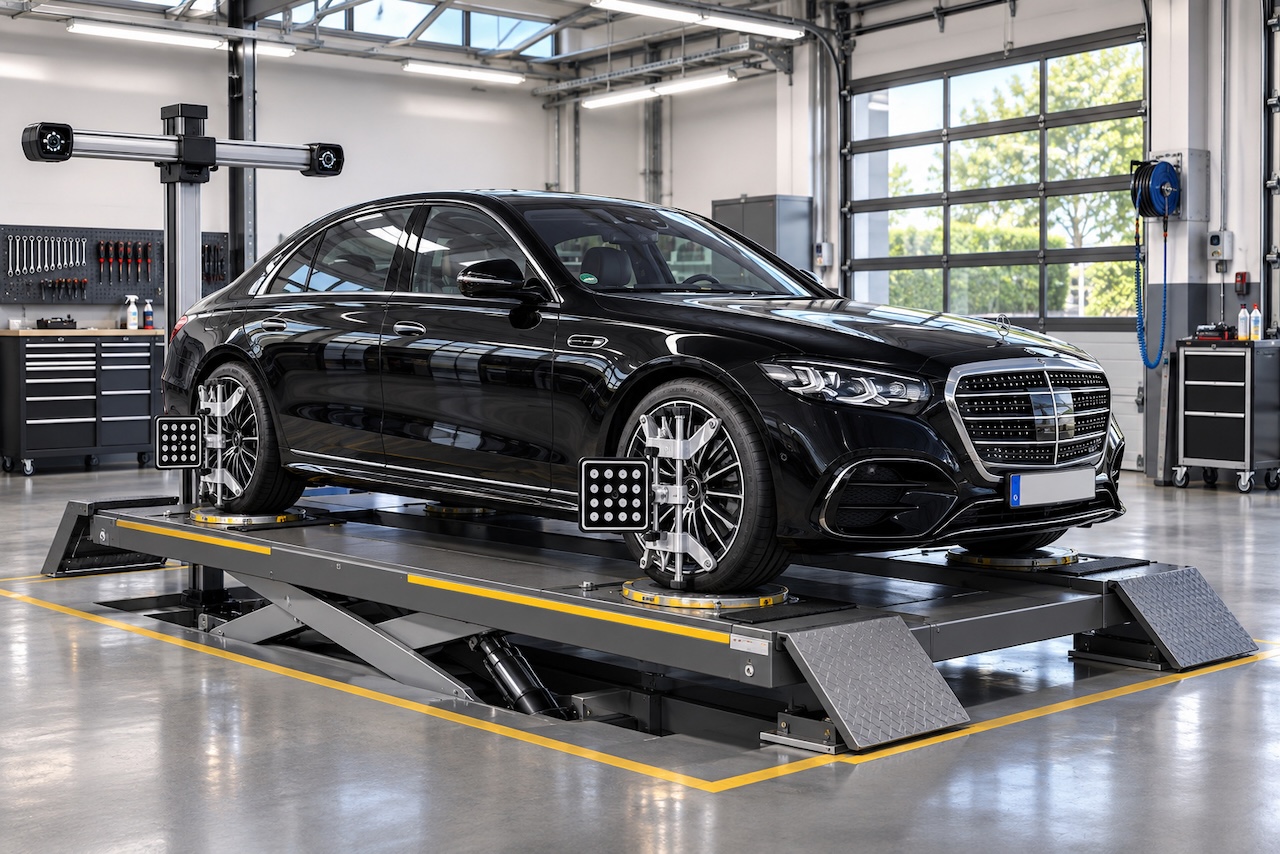
Signs of Bad Wheel Alignment
Quick Answer: Common signs are pulling to one side, an off-center steering wheel, wear on one side of a tire, and a change in steering response. Pressure, tires, brakes, or suspension can cause similar symptoms.
Common symptoms include pulling to one side, an off-center steering wheel, wear on one side of a tire, and a change in steering response. If the car started acting differently after a curb strike or pothole, an alignment or suspension inspection may be appropriate.
These symptoms do not prove the alignment is off. A tire with low pressure, an internal tire problem, or a brake that does not release properly can also cause pulling. A good inspection looks at all of those possibilities before anything is adjusted.
Why Your Mercedes-Benz Pulls Left or Right
Quick Answer: A car can pull because of alignment angles, uneven tire pressure, tire-related forces, worn suspension parts, or a brake problem. Road crown can also cause a slight drift on some surfaces.
Roads slope toward the edges so water drains, and that slope can cause a slight drift even on a properly aligned car. A strong pull that shows up on different roads, or a steering wheel you have to hold turned to go straight, is more concerning, and steady-speed drives on US-41 and I-75 make a consistent pull easier to notice. A technician often starts with tire pressure, tire condition, and suspension parts before measuring wheel geometry, which is what an alignment check covers.
Key Takeaways
- Pulling, an off-center steering wheel, and uneven wear can point to alignment.
- Pressure, tires, brakes, and suspension can cause the same symptoms.
- Have alignment checked after a hard impact.
Camber, Caster, and Toe in Plain Terms
Quick Answer: Camber, caster, and toe are the three angles an alignment measures. Each one affects steering feel, stability, and tire wear.
Alignment measurements describe how the wheels and steering geometry sit relative to the car:
- Camber: the inward or outward tilt of the wheel as seen from the front
- Caster: the angle of the steering axis as seen from the side
- Toe: the direction the wheels point relative to each other
Incorrect settings can change steering feel, directional stability, and tire wear. Equipment compares the readings with the specifications for your exact model, and adjustments are made only where the design allows. Damaged suspension parts may need repair before a final alignment is possible.
Alignment and Uneven Tire Wear
Incorrect toe or camber can cause fast, uneven tread wear, often visible on the inner or outer shoulder of a tire. Pressure, worn suspension parts, and driving habits can create similar patterns, so the cause needs to be confirmed. New tires will not correct an alignment problem underneath. If the old set wore unevenly, having alignment checked before or during replacement can help keep the pattern from coming back. Heavy wear on one edge is also one of the signs that tires need replacing. Rotation and balancing are part of tire maintenance services.
| Symptom | Possible Alignment Link | Other Possible Causes |
|---|
| Pulling to one side | Wheel angles out of specification | Uneven tire pressure, a tire problem, a brake that does not release, worn suspension parts |
| Off-center steering wheel | Toe or steering geometry has changed | A steering or suspension issue |
| Uneven tire wear | Toe or camber out of specification | Inflation, worn suspension parts, driving habits |
| Vibration at certain speeds | Less likely to be alignment alone | Tire or wheel imbalance, tire damage |
| Handling change after a pothole | Settings may have shifted | A bent or damaged tire, wheel, or suspension part |
Pulling, Off-Center Steering, or Uneven Wear?
Describe what you notice and when it started, and the team can check whether alignment is involved.
Schedule Service
Alignment vs. Wheel Balancing
Quick Answer: Alignment deals with wheel angles and how the car tracks. Balancing corrects uneven weight in the tire and wheel assembly.
Imbalance often shows up as vibration at certain speeds, while alignment problems tend to show up as pulling or uneven tread wear, though neither symptom belongs to only one cause. Both can happen together, and an inspection identifies which service is needed. The Mercedes-Benz Tire Center can also help with tire and wheel questions.
After a Pothole or Curb Hit
A hard impact can change alignment settings or damage a tire, wheel, steering part, or suspension component. Not every impact does damage, but a sudden change in handling afterward is a strong reason for an inspection. Watch for pulling, vibration, an off-center wheel, and visible tire damage. If the car feels unstable or a tire looks structurally damaged, do not keep driving as normal until it has been checked.
How Often Should Alignment Be Checked?
No single interval fits every model and driving pattern. Consider a check when symptoms appear, after a hard impact, when tire wear looks unusual, or after certain suspension repairs, and some owners ask for one when new tires go on. A check measures whether the angles are within specification, and it does not always lead to an adjustment. Alignment cannot solve every steering or vibration complaint.
Mercedes-Benz Wheel Alignment Questions in Bonita Springs, FL
How do I know if my Mercedes-Benz is out of alignment?
Quick Answer: Pulling, an off-center steering wheel, and uneven tire wear are common signs. An alignment measurement confirms whether settings are outside specification.
Can I drive with bad alignment?
Quick Answer: Minor issues may cause gradual tire wear, but strong pulling or unstable handling needs prompt attention. Stop if the car feels unsafe.
Does a crooked steering wheel mean my alignment is off?
Quick Answer: It can, though steering and suspension problems can also leave the wheel off-center.
Will an alignment stop steering wheel vibration?
Quick Answer: Not necessarily. Vibration more often relates to balance, tires, wheels, or other mechanical issues.
Can poor alignment wear out new tires?
Quick Answer: Yes. If wheel angles cause abnormal wear, new tires can develop the same pattern until the cause is fixed.
Should I check alignment after hitting a pothole?
Quick Answer: Yes, if the impact was hard or the car now pulls, vibrates, steers differently, or has a damaged tire.
Is wheel alignment the same as tire balancing?
Quick Answer: No. Alignment deals with wheel angles, while balancing corrects uneven weight in the tire and wheel.
Can a curb hit knock my Mercedes-Benz out of alignment?
Quick Answer: It can. A hard curb strike can change alignment settings or damage a tire, wheel, or suspension part, so have the car checked if it pulls or steers differently afterward.
Where can I get an alignment check in Bonita Springs?
Quick Answer: Mercedes-Benz of Bonita Springs Service Center offers alignment checks and related tire services.
Pulling, an off-center steering wheel, and uneven tire wear are worth checking, but each one has several possible causes. Measurement settles whether alignment is involved, and fixing the right cause protects both handling and tires.
Mercedes-Benz Alignment Check in Bonita Springs, FL
If your Mercedes-Benz pulls, feels different to steer, or shows unusual tire wear, the service team at Mercedes-Benz of Bonita Springs can help find out whether alignment is involved. Drivers in Bonita Springs and nearby Estero can send questions about symptoms through Contact Us before a visit.