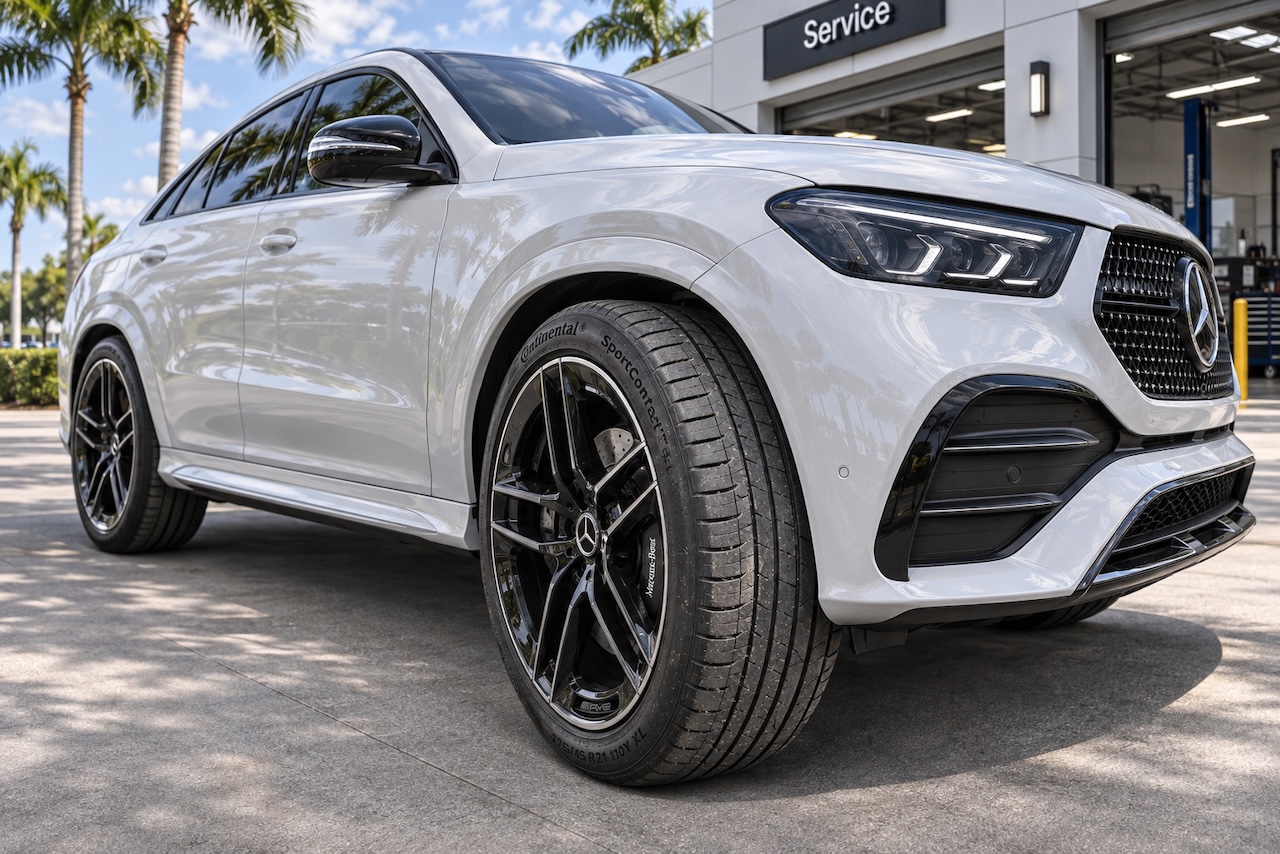
1. The Tread Is Getting Shallow
Quick Answer: Replace tires when tread is shallow enough that wet-road grip is fading or the wear bars are level with the tread. Grip can drop before the wear bars show.
Tread grooves channel water away from the contact area. As they wear down, wet-road traction can fade and hydroplaning becomes more likely. Built-in wear bars sit in the grooves and show when tread has reached its minimum, and a tread depth gauge lets you measure several spots on each tire. Wet-weather grip can drop before the wear bars show, so a tire does not need to be at its limit to be worth replacing.
2. The Wear Is Uneven
Quick Answer: Wear concentrated on one edge, the center, or both shoulders can point to alignment, inflation, tire, or suspension issues. A technician needs to inspect the car to find the cause.
A tire worn much more on the inside edge than the outside can point to an alignment concern. Overinflation and underinflation wear tread differently, and driving style and suspension condition play a part too. New tires installed without fixing the cause can wear unevenly as well, so if your car pulls or shows unusual wear, an alignment check before new tires is worth considering, especially when the car shows the signs of a wheel alignment problem.
3. You See Cracks, Cuts, or Sidewall Bulges
A bulge in the sidewall can mean damage to the tire's internal structure and deserves serious attention. Cuts and cracks can also weaken a tire depending on where they are and how deep they go, and visible damage calls for a prompt look even if the tire still holds air. Avoid driving on a tire with a bulge or major damage. Some punctures in the tread area can be repaired within recognized standards, but sidewall damage generally cannot, so a tire professional should decide whether replacement is needed.
4. The Car Feels Less Stable in Rain
Southwest Florida downpours can expose tires that are losing grip, and stop-and-go traffic on US-41 followed by highway speeds on I-75 asks a lot of a tire in a single trip. If braking or cornering feels less predictable on wet roads, worn tread, incorrect pressure, or an unsuitable tire may be part of the reason. Stability systems cannot create traction the tires no longer provide. Check pressure and tread before longer trips and as the seasons change instead of waiting for a major storm.
5. One Tire Keeps Losing Air
A puncture, leaking valve, wheel problem, or imperfect seal between tire and wheel can cause repeated pressure loss. Temperature swings change pressure a little, but a tire that loses noticeably more than the others needs inspection. The tire pressure monitoring system will not catch every problem early, so follow the pressure listed for your vehicle and have a persistent leak diagnosed instead of topping the tire up again and again.
6. Vibration or a New Noise Appears
Steering wheel vibration or a new road noise can come from tire damage, imbalance, a wheel problem, or a suspension concern, and the symptom alone cannot tell which. A technician may inspect the tire and wheel assembly, check balance, and look at related parts. If the vibration started after a pothole or curb hit, a closer inspection makes sense.
Key Takeaways
- Look at tread, wear pattern, sidewalls, pressure, noise, and tire age together.
- Never drive on a tire with a sidewall bulge.
- The right replacement plan depends on your model and drivetrain.
- Underinflated or misaligned tires can lower fuel efficiency without any obvious sign.
7. The Tires Are Aging Even if Tread Remains
Rubber ages with time, sunlight, heat, and use, so an older tire can need evaluation even with plenty of tread, which matters for cars that do not log many miles. The DOT Tire Identification Number on the sidewall includes the week and year of manufacture. Follow the age guidance from the vehicle and tire manufacturers, and have tires checked before a stored car returns to regular driving. Federal tire safety guidance explains how to read the DOT number and how to check pressure and tread.
| Quick Check | What to Look For | When to Get Help |
|---|
| Tread | Wear bars level with the tread, or shallow grooves | Have the tire inspected or replaced |
| Sidewalls | Cuts, cracks, or bulges | Stop driving on a tire with a bulge |
| Pressure | One tire that keeps dropping | Have the leak diagnosed |
| Wear pattern | Heavy wear on an edge or the center | Ask for alignment and suspension to be checked |
| Age | The date code in the DOT number | Follow the manufacturer's age guidance |
Tires Can Affect Fuel Efficiency Without You Noticing
Quick Answer: Underinflated, unevenly worn, or misaligned tires can lower fuel efficiency, and the change is gradual enough that most drivers never notice it. A tire and alignment inspection shows whether your tires are working against you.
Rolling resistance is the effort it takes to keep a tire moving, and low pressure, uneven wear, or wheels that are out of alignment can all increase it. Because the change happens slowly, it rarely stands out from one fill-up to the next. Heat and temperature swings in Southwest Florida also change tire pressure, so checking it with a gauge and keeping it at the level listed for your vehicle is one of the simplest ways to help your tires work as intended. If the car is also pulling, wearing tires on one edge, or needing air more often than before, those are good reasons to have the tires and alignment looked at together. A tire and alignment inspection can include checking tread depth, pressure, wear patterns, and sidewall condition, along with measuring wheel angles against specification.
Mercedes Original Tires and Matching Sizes
Quick Answer: Mercedes Original (MO) tires are developed and approved for applicable Mercedes-Benz vehicles. The tire still has to match your exact size and configuration.
Mercedes-Benz models have specific requirements for tire size, load rating, and speed rating. Mercedes Original (MO) tires are developed and approved for applicable Mercedes-Benz vehicles, and the tire you choose still has to match your exact vehicle configuration. Some models use different front and rear sizes, which limits rotation options. The Mercedes-Benz Tire Center can help with selection and installation.
Could Your Tires Be Hurting Your Fuel Efficiency Without You Realizing It?
Stop by for a tire and alignment inspection and let our team take a look.
Schedule Tire and Alignment Inspection
Two Tires or All Four?
Quick Answer: It depends on tire condition, drivetrain, size, and manufacturer guidance. A tire specialist can measure the full set and recommend the right plan.
It depends on tire condition, drivetrain, size, and manufacturer guidance. Large differences in tire circumference can cause compatibility concerns on some 4MATIC® all-wheel-drive models, and when only two tires are replaced, the remaining pair still needs to be assessed. A tire specialist can measure the full set and confirm whether front-to-rear rotation is allowed for your model. Rotation, balancing, and pressure checks fall under tire maintenance services.
Mercedes-Benz Tire Replacement Questions in Bonita Springs, FL
How can I tell if my Mercedes-Benz needs new tires?
Quick Answer: Low tread, uneven wear, cracks, bulges, repeated pressure loss, and changes in wet traction are common signs. An inspection confirms whether replacement is needed.
How long do Mercedes-Benz tires last?
Quick Answer: Tire life depends on the tire, the vehicle, driving habits, alignment, inflation, and road conditions. No single mileage fits every model.
Can Florida heat shorten tire life?
Quick Answer: Heat and sun exposure can speed up tire aging. Correct pressure and regular inspections matter most in warm climates.
Should I replace all four tires at once?
Quick Answer: Not always. Tire condition, remaining tread, model, and drivetrain decide whether one, two, or four tires should be replaced.
Can bad alignment wear out tires early?
Quick Answer: Yes. Incorrect alignment can cause uneven wear, though pressure and suspension problems can look the same.
Is a sidewall bulge dangerous?
Quick Answer: A bulge can signal internal damage and a risk of sudden tire failure. Avoid driving on a tire with a visible bulge.
Can I rotate my Mercedes-Benz tires?
Quick Answer: It depends on tire sizes, tread direction, and vehicle setup. Some models with different front and rear sizes cannot be rotated in the usual way.
Can worn or underinflated tires hurt fuel efficiency?
Quick Answer: Yes. Low pressure, uneven wear, and poor alignment can increase rolling resistance, which can lower fuel efficiency. A tire and alignment inspection shows whether your tires are a factor.
How often should I check tire pressure in Florida heat?
Quick Answer: Check pressure regularly and before longer drives, since heat and temperature swings change tire pressure. Use the pressure listed for your vehicle.
Where can I get tires replaced in Bonita Springs?
Quick Answer: Mercedes-Benz of Bonita Springs Service Center offers tire inspection and has a Tire Center with Mercedes Original (MO) tires. The team can help select tires that fit your vehicle.
Low tread, uneven wear, damage, repeated pressure loss, and fading wet grip are all reasons to have tires looked at, and age matters too. An inspection checks the whole tire and the car underneath it, so the replacement plan fits your vehicle.
Tire and Alignment Inspection in Bonita Springs, FL
A tire and alignment inspection looks at tread, pressure, wear patterns, and wheel angles together, so concerns about fuel efficiency, handling, or uneven wear get answered in one visit. Mercedes-Benz of Bonita Springs Service Center serves drivers in Bonita Springs and nearby Estero, and the team can help find tires that suit your vehicle. Questions before a visit can go through Contact Us.